Fraud use cases for banks and fintechs
15 attacks, each told as it happens: how it unfolds, which checks it passes on its own, what DeepID reads, the decision it returns and the words the customer sees.
Scams
The genuine customer is deceived and authorises the payment herself. Every coached payment needs three things: a call to keep her on, a payee to send the money to, and checks that she passes because she is real.
Digital arrest
Hold the coerced payment before it leaves the account.Hold, then call backInvestment scams
Slow the scam payment and hold the mule trading account.Warn, then cool offVulnerable customers
Extra time, and a call back, for the customers most at risk.Cool off, then hold
Mules
Stolen money needs accounts to land in and routes to leave by. Each account looks ordinary on its own; the ring shows when faces, devices and payees are linked.
Mule accounts
Catch mule accounts before the money moves.Cool off, then holdMerchant laundering
Hold the payout and find the whole merchant ring.HoldCrypto off-ramps
Hold the withdrawal before scam money goes offshore.HoldRemittance mules
Read the sender and the receiver before the transfer leaves.Hold or block
Deepfakes
A generated face or a built identity passes a check made for photos. The evidence sits below the picture: the camera, the device and the form.
Video KYC deepfakes
A live person, in front of a real camera, on every video KYC call.Step up, hold or blockExecutive deepfakes
Verify the approver on their own phone before an unusual payment leaves.Step upLoan stacking
Catch stacked and synthetic applications before disbursal.Cool off or blockClaims deepfakes
Pay clean claims without an extra step, and hold the fabricated ones.Hold, or allow
Account access
The attack arrives through recovery, an agent, an employee or software, with valid credentials. The person holding them is the question.
Account takeover
Protect the account through recovery and the hours after.Step up, then cool offAssisted channels
Prove the customer is there, on her own phone, before an assisted action.Step up, or holdAI agents
Tell the customer’s own assistant from automation that only looks like one.Allow, or step upInsider fraud
Hold the takeover that starts with a contact change made from the inside.Step up, then hold
One pattern runs through all 15.
Each check looks at one moment, and each moment looks clean. The attack shows only when the person, the phone and the payment are read together across the journey: a live person on her own phone, acting by her own choice, paying a payee away from mule rings.
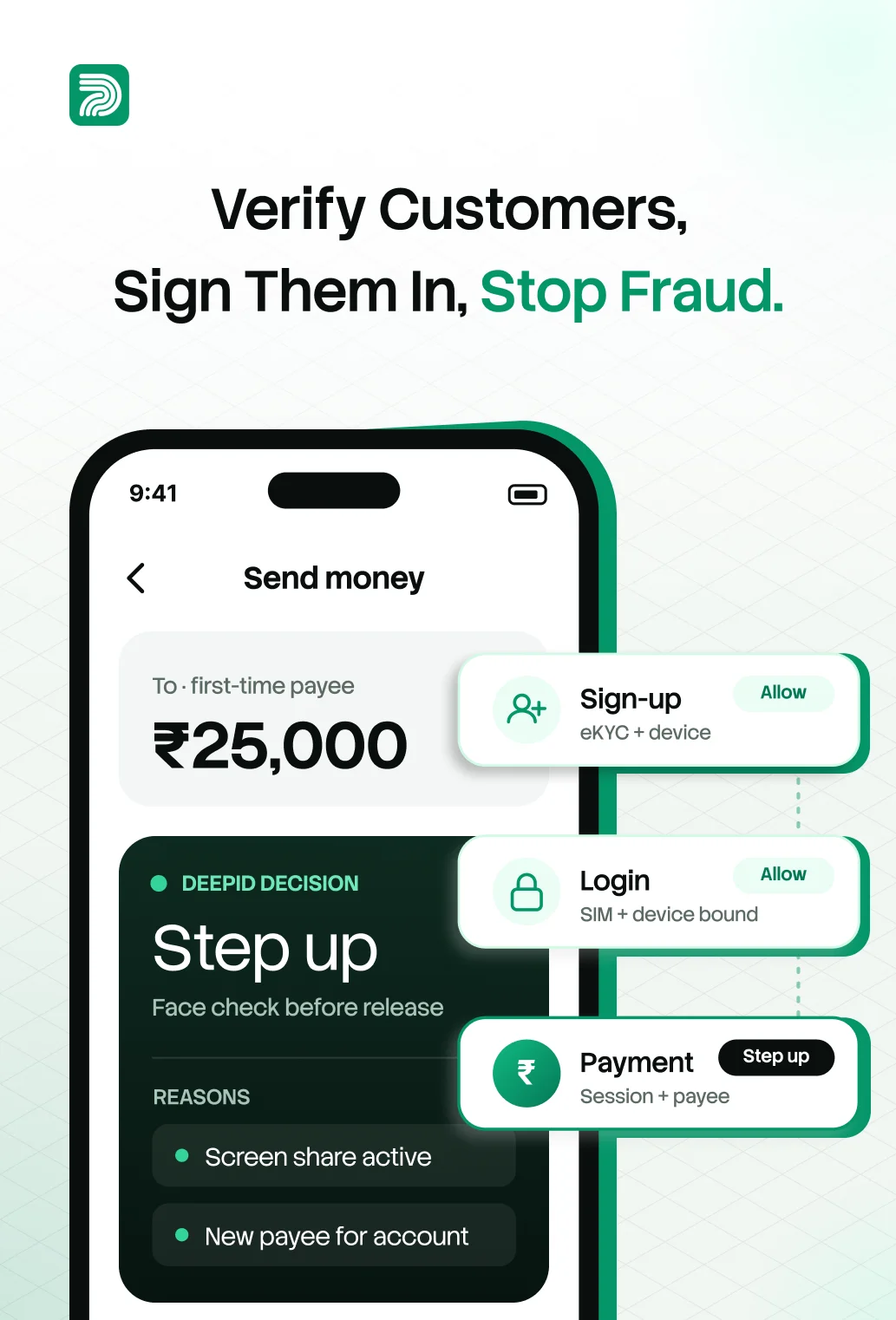
That is why every page sets what your checks saw beside what DeepID read at the same step, and ends in one of six actions with its reasons, not a score.
Abuse on consumer apps.
Not scams on a bank account but abuse of the app itself: one person behind many accounts, offers claimed again and again, and bots copying what you publish. The device behind them is what links them.
Promo abuse
Each offer claimed once per real customer.Step up, or blockMulti-accounting
Many accounts on one phone, linked at sign-up.Warn, step up or blockFake accounts
Fake profiles stopped before they post or collect.Step up, or blockReferral fraud
Referral loops stopped before they pay out.Step up, or holdAccount sharing
Sharing seen, and loyal members left alone.Warn, or step upContent scraping
Catalogues and prices kept away from bots.Step up, or block
Start with what your history can show.
A free retrospective on 30 to 90 days of your own transactions shows the payee and mule links in them. Session signals follow in a shadow proof, once the SDK runs.