A caller with leaked details passes the security questions, has the password reset and the number changed, and a new phone logs in and empties the account. DeepID treats recovery as a new-phone event: the customer’s face from sign-up has to hold before anything is bound again, and a cool-off limits what can leave in the hours after.
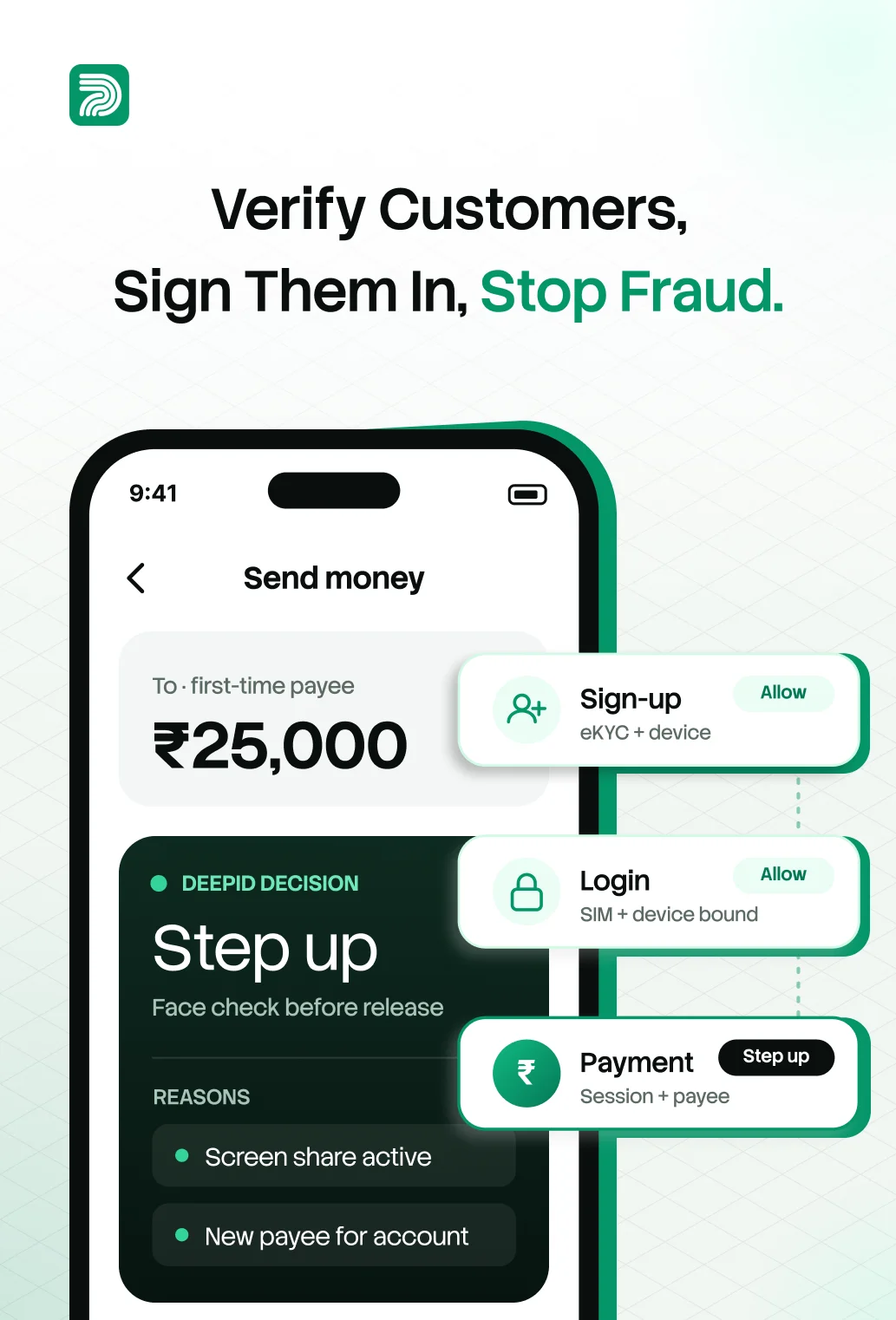
The decision at the last step, as your console shows it. Real codes and their names are agreed in the sandbox.
On this page
Protect the account through recovery and the hours after.
A caller tells the contact centre that they have lost their phone. They give the right name, date of birth and address and answer each security question. The agent resets the password and updates the mobile number. Soon after, a new phone logs in, adds a payee and empties the account. The customer learns of it when her own login fails.
An illustrative scenario, not a real customer’s case.
Step by step.
1
Leaked details are gathered
The attacker collects the customer’s personal details from breach data and phishing and prepares answers to the questions a contact centre is likely to ask.
Your checks saw
Nothing. Preparation is outside every channel.
DeepID reads
Nothing yet. The phone number and device used in earlier takeovers are already on the graph.
2
The reset, or a SIM swap
The attacker calls the contact centre, passes the knowledge questions and asks for a reset or a new registered number. Or the SIM is swapped at the operator, so every one-time code reaches the attacker.
Your checks saw
Security questions passed. Number updated.
DeepID reads
A SIM that moved to another phone 2 hours ago, and a new number requested from a contact already linked to a takeover.
3
A new phone logs in
The attacker logs in with the new credentials on a phone the bank has never seen and tries to register it as the customer’s. They head straight for payees and limits.
Your checks saw
Correct credentials. Valid one-time code.
DeepID reads
A new device within hours of recovery, and typing and navigation unlike the owner’s. Re-binding waits for a face check against the face from sign-up.
4
The account is emptied
Transfers go to new payees in quick succession until the balance or the limit runs out.
Your checks saw
An authenticated session. Payments within limits.
DeepID reads
New payees and payments inside the cool-off, on a session that does not match the owner. The first large one is held.
Each check, on its own.
Each of these trusts the credential, not the person holding it. Read together across the journey, they stop agreeing, and that is what DeepID reads.
Knowledge questions
Leaked and phished data gives the attacker the same answers the genuine customer would give.
SMS one-time password
After a SIM swap or a change of registered number, the code is delivered to the attacker.
New device rules
A login on a new phone after a reset looks the same as a genuine customer who changed phones.
Contact-centre judgement
Agents are measured on speed and service, and an attacker can keep calling until one helps.
Before a new phone or SIM is bound, the customer passes a face check with liveness matched to the face from sign-up. Leaked data can answer a knowledge question; it does not produce a live face.
The account is bound to one device and SIM. A SIM moved to another phone, a new device and a new number, each ordinary alone, within hours of a reset is the takeover pattern, and the binding does not follow until the customer proves it is them.
One-tap login asks the network and the SIM to confirm the number before any code is sent. A number that cannot be confirmed on the SIM in this phone falls to the next check, and is not bound until one verifies.
Typing, touch and navigation in the first session compared with the owner’s history. An attacker heads straight for payees and limits and handles the app in a way the owner never has.
The phone number and device used in the recovery linked to other accounts and earlier cases. Attackers reuse the same contacts across customers, so one confirmed takeover helps expose the next.
The decision.
Step up every recovery on a new phone or after a SIM change to a face check against the face from sign-up, cool off new payees and larger payments for the hours after, and hold a payment when the first session does not match the owner. Who the agent calls, and on which number, stays your contact-centre process.
Allow
Recovery from the bound phone with no SIM change and no linked contacts. It completes as normal, and the reasons are logged.
Step up
A new device or a recent SIM change around the request. The customer completes a face check with liveness before anything is re-bound or changed.
Cool off
Recovery completed on a new phone, number or email. New payees and larger payments wait for the cool-off set for your market, while the first session is read.
Hold
The first session does not match the owner and a payment to a new payee starts. The payment waits, and your fraud team receives the reasons.
Block
The face does not match the one from sign-up, or the new number is linked to confirmed takeovers. The recovery is refused, the existing binding stays and a case is opened.
“Is this your new phone? Your SIM moved to a new phone. Before you carry on, we need to check it’s you.”
Shown on the new phone at the first login after recovery. Illustrative.
Reasons sent to your FRM.
The same decision reaches your FRM, case manager or SIEM as an event, with one code per reason. The codes here are illustrative; real codes and their names are agreed in the sandbox.
SIM_SWAP_RECENTSIM for this number swapped 2 hours before the request
NEW_DEVICENew device at the first login after recovery
BEHAVIOUR_DRIFTTyping and navigation unlike the account owner’s
STEP_UP_FACEFace check against the face from sign-up requested before re-binding
What to measure in a pilot.
Agreed in writing before the pilot starts, and counted on your own traffic against what you see today. Numbers and devices reused across past takeovers can be found in a retrospective. The face check and the first-session behaviour are proved in a shadow proof on live sessions. We publish no figures for these.
Takeovers that began in recovery, against today
Recoveries stepped up or refused that you later confirm as attacks
Payments held in the first session after recovery that you later confirm as fraud
Genuine customers delayed by the cool-off, against the tolerance you set
Change in contact-centre handling time
Questions fraud teams ask.
Will the cool-off frustrate genuine customers with a new phone?
Some will meet a short wait on new payees and larger payments, and that is the trade the control makes. Recovery from the bound phone passes as normal, and you set the length of the cool-off and the actions it covers, per market. The shadow proof shows how many genuine customers would be affected.
Do you need SIM-swap data from the mobile operators?
No. The SIM check and the network check read the SIM in the phone directly, and the binding records when it changes. Where you already receive SIM-swap feeds, they can sit beside it.
Does this replace our contact-centre checks or voice biometrics?
No. DeepID does not check voices or listen to calls. It adds the face check on the customer’s own phone, the SIM and device binding and the first-session behaviour beside whatever your contact centre already runs, so no single check carries the whole recovery.
Rules it supports.
The controls below are the binding, authentication and cool-off measures on the rule map: in India, RBI’s authentication directions; in Singapore, the 12-hour cooling-off under the Shared Responsibility Framework; in Malaysia, one registered device per account.
Bind the customer to the phone
SIM and device binding at onboarding and re-binding on change, with the number confirmed by the network and device integrity read every session.
One-tap login that tries the network check, the SIM check and Aadhaar consent before any one-time code, and face checks with injection defence where identity is in doubt.