
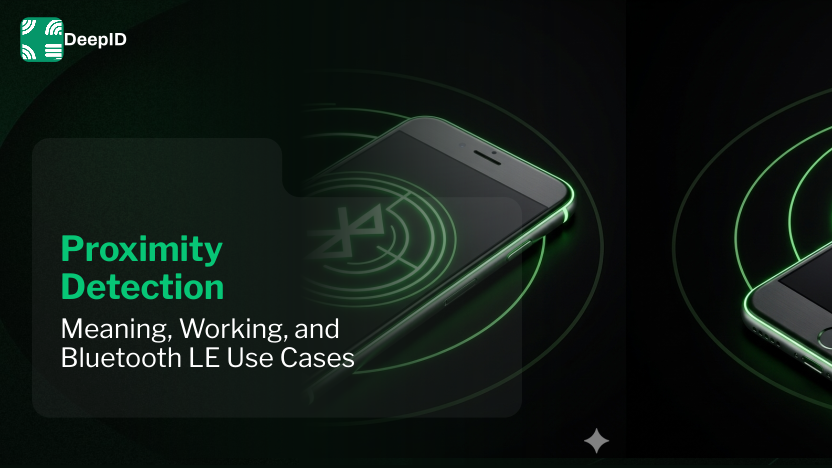
Proximity Detection: Meaning, Working, and Bluetooth LE Use Cases
Vijay Kandari
Digital Marketing Executive
Summarize this article with
Have you wondered why your app delivers a discount when you enter a store? Or why does your phone unlock when you're near your vehicle? These are some examples that show proximity detection in everyday practice. It allows one mobile device to communicate with another mobile device, enabling the devices to each end ‘Hello, I’m here’ to the other one. This eliminates the need for complex maps. Devices that employ proximity detection ask ‘Is that object His Honor’ and answers ‘Yes, we are in His Honor".
Proximity Detection Meaning
To put it simply, proximity detection is the ability of a system to determine if an object is within a certain range. It is not about knowing exactly where something is on a map; it is about knowing how "close" it is to a sensor.
Proximity vs. Exact Location
It is easy to confuse proximity with location tracking (like GPS), but they are different:
Exact Location Tracking: This tells you the specific coordinates (latitude and longitude) of an object. It answers the question, "Where is it?"
Proximity Detection: This tells you the relative distance between two points. It answers the question, "Is it near me?"
For example, a GPS tells you that your friend is at the mall. Proximity detection tells you that your friend is standing right behind you.
How Proximity Detection Works
Proximity detection works by using signals and sensors. Most systems use radio waves, sound, or light to "feel" the environment. When a device sends out a signal, it waits to see how that signal is received by another device.
The Role of RSSI
The most common way to measure closeness is through RSSI, which stands for Received Signal Strength Indicator.
Think of RSSI like a person shouting in a large field. If the person is standing next to you, their voice is very loud (a strong signal). As they walk away, their voice gets quieter (a weak signal). By measuring how "loud" or strong a radio signal is, a device can estimate how far away the sender is.
Why Distance is an Estimate?
It is important to know that RSSI provides an estimate, not an exact measurement. Radio signals do not always travel in a straight line. They can bounce off walls, get absorbed by furniture, or be blocked by people. This is why signal strength can fluctuate (change quickly) even if you aren't moving. Because of these fluctuations, proximity systems usually talk about "zones" (like Near, Immediate, or Far) rather than exact inches or centimeters.
Bluetooth LE Proximity Detection
While there are many ways to detect proximity, Bluetooth Low Energy (BLE) is the most popular choice today. BLE is a "lite" version of the Bluetooth we use for headphones. It is designed specifically to send small amounts of data while using very little battery power.
How BLE Detects Proximity
BLE devices, often called "beacons," send out tiny packets of data many times per second. Your smartphone "listens" for these packets. When it hears one, it looks at the RSSI. If the signal is strong, the phone knows it is very close to the beacon.
Why Use BLE?
BLE is the industry standard for several reasons:
Low Power: A BLE beacon can run on a single small battery for years.
Universality: Almost every modern smartphone has a Bluetooth chip.
Cost: BLE hardware is very inexpensive to make and install.
Use Cases of Proximity Detection
Proximity detection is used in almost every industry. Here are a few ways it works in the real world:
Contact Tracing: During health crises, proximity detection helps track the spread of illness. If two phones are within six feet of each other for more than 15 minutes, the system logs a "close contact." It doesn't need to know where the people were, just that they were near each other.
Retail and Marketing: Stores use BLE beacons to improve the shopping experience. If you walk near the electronics section, the store's app might detect your proximity and send a notification about a sale on headphones. This is much more effective than a general ad because it happens exactly when you are near the product.
Indoor Navigation: GPS often fails inside big buildings like airports or hospitals. Proximity detection solves this. By placing beacons throughout a building, a phone can detect which beacon is closest and show your position on an indoor map.
Security and Authentication: Many modern offices use proximity for "hands-free" security. When an employee walks up to a locked door, the door's sensor detects the BLE signal from their digital badge or phone. If the signal is strong enough (meaning they are right at the door), it unlocks automatically.
Challenges and Limitations of Proximity Detection
Proximity detection is great, but it isn't perfect. Several factors can mess with the signal:
Signal Interference: Other electronics or Wi-Fi signals can get in the way of BLE signals.
Environmental Impact: Water and metal are the "enemies" of radio signals. Since the human body is mostly water, a crowd of people can actually block signals and make a device seem further away than it is.
Device Differences: Not all phones are built the same. An iPhone might measure a signal differently than a Samsung phone, leading to different distance estimates for the same spot.
How Accuracy is Improved
To fix these problems, engineers use several "value-add" techniques to make proximity detection more reliable:
Signal Filtering: Instead of looking at just one signal measurement, systems use filtering. They take many measurements over a few seconds and average them out. This "smooths" the data and removes the random jumps in signal strength caused by interference.
Using Multiple Data Points: Sometimes called "trilateration," this involves using more than one beacon. If a phone is near three different beacons, the system can compare the signal strengths from all three to get a much better idea of where the person is standing.
Calibration: Technicians can "tune" a system for a specific room. They walk around the room and tell the system what the signal strength should look like at certain spots. This helps the computer understand how the walls and furniture in that specific room affect the signal.
Conclusion
Proximity detection forms a link from the physical world to the digital world. Signal strength (RSSI) is one of the most common ways to signal relative closeness. Precise location is not the most pertinent sense of the word. Technologies like Bluetooth Low Energy (BLE) are used because they are versatile and require a lower battery life. Technology like this is not without its environmental challenges, like physical barriers causing signal malfunctions. Many smart calibrations have signal filtering, and have room calibrations, and filters. Proximity detection can be applied to secure access to buildings, indoor navigation, and retail use for customization.
FAQs
Ques: What is proximity detection?
Ans: Proximity Detection refers to a device’s ability to sense when something is nearby without needing its exact location.
Ques: What is RSSI in proximity detection?
Ans: Received Signal Strength Indicator or RSSI measures how strong a signal is and helps in proximity detection by helping the devices understand how close a device is.
Ques: What is Bluetooth Low Energy Proximity Detection?
Ans: Bluetooth LE proximity detection is a lite version of proximity detection for headphones. It is made to send small amounts of data over Bluetooth without using much power.
Ques: What affects the BLE signal strength?
Ans: Things like walls, metal objects, water (including human bodies), and other electronic signals can weaken or block BLE signals.
Ques: Does proximity detection work indoors?
Ans: Yes, proximity detection can work indoors.
All article tags
Related Articles
September 28, 2026
What is Behavior Analysis and how does it prevent fraud?

September 10, 2026
How to Prevent Password Sharing: A Complete Guide for SaaS & Streaming Platforms

August 31, 2026
How to Prevent Coupon Fraud? Effective Strategies
August 27, 2026
DoT SIM Binding Mandate Explained: Compliance Guide for Communication Apps (2026)
Identify your web and
mobile traffic in minutes
Collect visitor IDs and signals instantly for free,
or reach out to our team for a demo.
250+
countries and territories where we identified devices_
4 Billion +
unique browsers and mobile devices identified_
50 Million +
real-time device intelligence API events per day processed_