
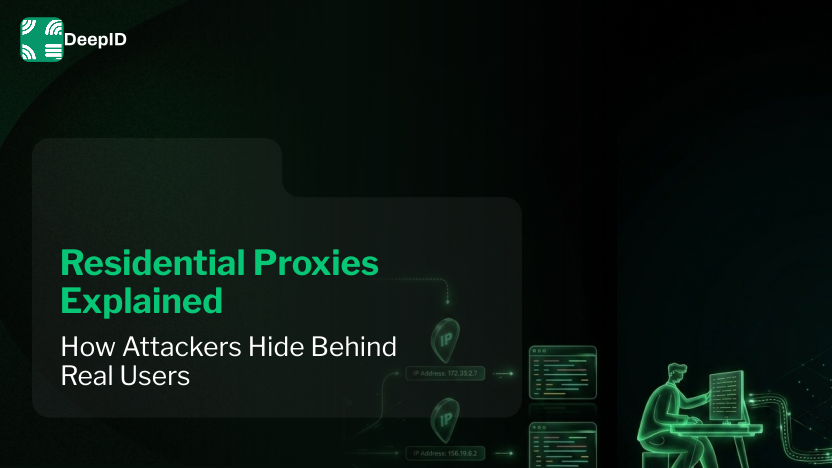
Residential Proxies Explained: How Attackers Hide Behind Real Users
Vijay Kandari
Digital Marketing Executive
Summarize this article with
For modern cybersecurity attacks, fraudsters use residential proxies to hide their activity behind residential IP addresses, to bypass firewalls that can detect threats like credential stuffing. In this blog we will explore what a Residential Proxy is, how it works, and how businesses can detect whether residential proxies are being utilized on their platforms.
What Are Residential Proxies?
A residential proxy acts as a middleman between a fraudster and an internet connection from a person’s house that lets them access the internet from a different I.P address and lets them hide their identity.
How Do Residential Proxies Work?
Fraudsters build a massive "P2P" (Peer-to-Peer) network to hide behind residential I.P addresses. They do this by:
IP Acquisition: The fraudster scans the internet to find routers that have outdated hardware through which they get access to a different wifi connection.
Routing the Request: When a fraudster wants to reach a target website, they send their request to the proxy’s gateway server.
The Residential Relay: The gateway server selects an available residential IP from all the residential connections it has access and relays the internet connection through that home network.
Target Interaction: The target website sees the request coming from the homeowner's IP. It processes the request and sends the data back through the same residential node to the attacker.
Residential Proxies vs. Datacenter Proxies
Historically, attackers used datacenter proxies. These are IPs owned by cloud providers like AWS, Azure, or DigitalOcean. While fast and cheap, they are incredibly easy for security teams to identify and block.
IP Source: Datacenter proxies come from secondary corporations or cloud data centers, while residential proxies are sourced from real ISPs like Comcast, AT&T, and Verizon.
Trust Level: Datacenter proxies have a low trust level as they are often flagged as bot-like, whereas residential proxies have a high trust level because they appear like real users.
Detection Ease: Datacenter proxies are easy to detect due to static and known IP ranges, while residential proxies are harder to detect because their IPs are dynamic and blended with genuine user traffic.
Cost: Datacenter proxies are very cheap, whereas residential proxies are comparatively expensive.
Speed: Datacenter proxies offer extremely high speed due to strong infrastructure, while residential proxies provide moderate speed as they rely on home network connections.
Stability: Datacenter proxies are highly stable, whereas residential proxies have lower stability since nodes may go offline when users turn off their devices.
Why Attackers Prefer Residential Proxies
The primary goal of any digital attacker is to remain undetected for as long as possible. Residential proxies provide the ultimate camouflage for several key reasons:
1. Bypassing IP Reputation Filters
Most security solutions use IP reputation as a first line of defense. If an IP is known for sending spam or being part of a server farm, it is automatically throttled or blocked. Residential IPs belong to legitimate households, meaning they rarely appear on "dirty" IP lists until they are heavily abused.
2. Mimicking Human Behavior
Attackers use residential proxies to perform Credential Stuffing and Account Takeover (ATO) attacks. By rotating through thousands of different home IPs, they can attempt one or two logins per IP, staying well under the rate-limiting thresholds that would trigger an alert.
3. Precision Geo-Targeting
Many services—from streaming platforms to banking portals—limit access based on geography. Attackers often buy proxy residential access specifically to appear as if they are located in a high-trust region or the same city as the victim whose account they are trying to breach.
4. Avoiding CAPTCHAs and Bot Detection
Advanced bot detection systems analyze the "fingerprint" of a connection. Requests coming from residential networks are less likely to be served a CAPTCHA because the system assumes a person is behind the screen. This allows for massive-scale Web Scraping and competitive intelligence gathering without being banned.
5. Ad Fraud and Social Media Manipulation
In ad fraud, attackers use residential proxies to simulate "clicks" or "views" from different households, making the fake traffic appear organic and high-value. Similarly, they are used to create thousands of fake social media accounts that appear to be run by real individuals across a country, rather than a "bot farm" in a single building.
Free Residential Proxies — Are They Really Free?
The temptation to find free residential proxies is high for low-level hobbyists or budget-conscious attackers, but these services carry immense risks. In the security world, if you aren't paying for the product, your device (or your data) is likely the product.
Botnet Participation: Many "free" proxy services are actually built on botnets. By using a free proxy, you may be routing your traffic through a device that was compromised via malware.
Data Interception: The operator of a free proxy can see all unencrypted traffic passing through their "node." This makes users of free proxies vulnerable to Man-in-the-Middle (MITM) attacks.
Legal Liability: If you use a free residential proxy that is actually part of a malicious botnet, your own activities may be logged alongside criminal activity, leading to legal complications.
For defenders, it is important to realize that a portion of the "residential" traffic they see may be originating from regular users who have unknowingly installed "proxyware" as part of a free software bundle.
How Security Teams Can Detect Residential Proxy Abuse
Detecting a residential proxy is significantly harder than detecting a datacenter IP, but it is not impossible. Security professionals must move beyond simple IP blacklisting and adopt a multi-layered approach:
Behavioral Analytics
Instead of looking at who the IP is, look at what the IP is doing. A residential user typically browses at a certain speed, clicks on elements, and follows a logical path through a site. A bot using a residential proxy often behaves in a more linear, "inhuman" fashion—accessing pages in a specific order at precise intervals.
Device Fingerprinting
While the IP address might look residential, the device behind it might not match. If a request comes from a residential ISP in London, but the browser fingerprint reveals a Linux server configuration or inconsistent header data (like a mismatch between time zones and IP location), it is a strong signal of proxy usage.
Velocity Checks
Track the frequency of actions across your entire network, not just per IP. If you see 5,000 login attempts for 5,000 different accounts across 5,000 different residential IPs within the same minute, you are likely witnessing a coordinated residential proxy attack.
IP Intelligence and ASN Analysis
Advanced IP intelligence providers can identify the Autonomous System Number (ASN) associated with an IP. While many are genuine ISPs, some specialized ASNs are known to be heavily utilized by residential proxy "providers." Mapping these relationships can help identify high-risk traffic.
What Businesses Should Do to Protect Themselves
To defend against the sophisticated use of residential proxies, organizations should implement the following:
Implement Multi-Factor Authentication (MFA): Since residential proxies facilitate account takeover, MFA is the most effective way to ensure that even if an attacker "looks" like a user, they cannot gain access without the second factor.
Deploy Bot Management Solutions: Use specialized bot detection tools that utilize machine learning to identify the subtle patterns of proxied traffic.
Monitor "New" IP Patterns: Be wary of a sudden influx of traffic from residential ranges that have never interacted with your site before, especially if they are targeting sensitive endpoints like /login or /checkout.
Educate Users on Proxyware: Inform your employees and customers about the risks of downloading "free" VPNs or apps that turn their devices into residential proxy nodes.
Utilize Behavioral Biometrics: Analyze how a user moves their mouse, types on their keyboard, or interacts with a touchscreen. These patterns are nearly impossible for a bot to replicate, regardless of the IP address they use.
Conclusion
Residential proxies have made digital attacks even more dangerous by providing fraudsters with an effective way to hide their identity. By routing traffic through a household connection, attackers can mimic human behavior and bypass reputation filters easily. This helps security teams to focus on multi-layered defenses such as behavioral analytics, device fingerprinting and MFA as opposed to static IP blacklisting alone. Ultimately, safeguarding against proxy abuse requires developing an understanding of how attackers hide behind pseudonyms while being vigilant at identifying malicious intentions through subtle patterns in non-human interactions - it requires both understanding attackers hiding behind pseudonyms as well as uncovering patterns non-human interactions revealing malicious intent hidden beneath their surface.
FAQs
Ques: What is a residential proxy?
Ans: A residential proxy is a bridge between a fraudster and the internet which the fraudster uses to access the internet from someone else’s internet connection.
Ques: Why do fraudsters prefer residential proxies?
Ans: Fraudsters prefer residential proxies more than as it helps them bypass detection systems and mimic real user behavior to carry out their cyber attacks.
Ques: Are residential proxies legal?
Ans: Yes, residential proxies are legal but misusing them for online scams and bypassing security is a serious offense which can result in big consequences.
Ques: How can businesses detect residential proxy usage?
Ans: Behavior analysis, device fingerprinting, velocity checks, and IP Intelligence are some of the many solutions to detect residential proxy usage.
Ques: What is the best way to prevent attacks using residential proxies?
Ans: Implementing multi-factor authentication (MFA), bot detection tools, behavioral biometrics, and monitoring unusual traffic patterns are the most effective ways to prevent such attacks.
All article tags
Related Articles
September 28, 2026
What is Behavior Analysis and how does it prevent fraud?
September 10, 2026
How to Prevent Password Sharing: A Complete Guide for SaaS & Streaming Platforms

August 31, 2026
How to Prevent Coupon Fraud? Effective Strategies
August 27, 2026
DoT SIM Binding Mandate Explained: Compliance Guide for Communication Apps (2026)
Identify your web and
mobile traffic in minutes
Collect visitor IDs and signals instantly for free,
or reach out to our team for a demo.
250+
countries and territories where we identified devices_
4 Billion +
unique browsers and mobile devices identified_
50 Million +
real-time device intelligence API events per day processed_