
Mule Account Meaning: How Money Mule Scams Work and How to Stay Safe?
Vijay Kandari
Digital Marketing Executive
Summarize this article with
Financial transactions have become effortless in today's digital economy but such advances also give cybercriminals ways to hide their activity. Scammers frequently use money mule accounts to transport stolen funds and white-wash the money so it becomes harder to track. Using mule accounts could have devastating legal and financial repercussions and understanding how they work and important to protect your financial information, let's discuss this in this blog.
What Is Mule Account Meaning
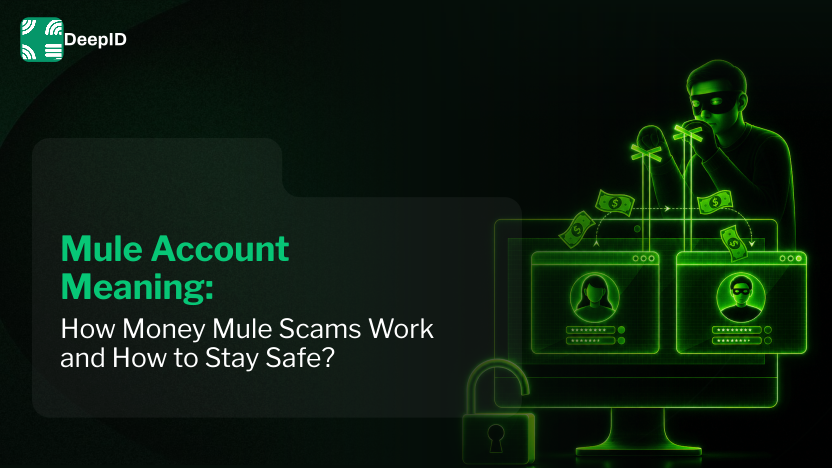
Mule accounts are used by scammers and money launderers to "carry" or move stolen funds. Scammers avoid using their own bank accounts because police would quickly detect it - instead, they use someone else's to move stolen money around.
Money mules serve as a bridge between criminal activity and individuals who commit them, often without even realizing it themselves; their owners are known as money mules. Unfortunately, many innocent people unwillngly become money mules without even realizing it - thinking they are helping a friend or starting their new job!
Example
Imagine you see an ad for a "Work from Home" job. The "boss" says your only task is to receive money in your account and then wire it to a different person.
They tell you to keep 10% as your commission. It sounds like easy money, right?
In reality, that money was stolen from someone else. By moving it, you are helping a criminal. Your bank account has just become a money mule account.
How Mule Accounts Work
The process of using mule accounts usually follows a simple, fast-paced pattern. Scammers want to move the money before the bank notices something is wrong.
Step 1: The Theft:
The scammer acquires funds by either phishing emails, creating fake romantic relationships or selling items that don't exist.
Step 2: The Recruitment
Scammers look for someone willing to act as their mules - often students, people searching for work, or those using dating apps as potential victims.
Step 3: Transfer
The scammer then transfers the stolen funds into the account of their money mules by telling them it is for either "business payments" or loan repayment.
Step 4: The Layering
The mule is told to move the money quickly. They might be asked to:
Transfer it to another bank account.
Withdraw it as cash and deposit it elsewhere.
Buy cryptocurrency or gift cards with it.
Step 5: The Disappearance
Once the money is moved, the "clean" funds reach the criminal. The trail is now cold, and the criminal is hard to find.
The Three Types of Money Mules
Not every person with a mule account is a criminal. Experts usually group money mules into three categories:
The Unwitting Mule: These people don't realize they are doing anything wrong, often being duped into scams themselves. For instance, they might think they are helping out an online "romance", or performing some sort of secret shopper mission for someone they met online.
The Witting Mule: This individual may experience doubt, such as when being asked to use their personal account for another's money. Yet they choose to ignore any warning signs in pursuit of easy money.
The Complicit Mule: These people know exactly what they are doing when working with criminals to move stolen money for them in exchange for fees. These accomplices might open multiple mule accounts just for this purpose.
The Serious Risks of Mule Accounts
You might think, "I'm just moving money, what's the big deal?" In reality, the consequences are life-changing.
Even if you didn't know the money was stolen, you can still face trouble.
Legal Consequences: Money laundering is a serious crime. If your account is used as a money mule account, the police will come to you first. You could face heavy fines or even go to prison.
Bank Account Freezing: Banks have smart systems to track mule accounts. If they see suspicious activity, they will freeze your account. You won't be able to pay your bills or get your own salary.
Criminal Charges: You could end up with a permanent criminal record. This makes it very hard to get a job, a house, or a loan in the future.
Impact on Your Credit: Most banks will refuse to let you open an account ever again. Being labeled as a "fraud risk" stays with you for a long time.
How People Get Tricked
Scammers are very good at lying. They use emotions and "get rich quick" promises to find people for mule accounts.
Fake Job Offers: They offer high pay for "Payment Processing Agents."
Romance Scams: A person you met on a dating app asks you to "hold some money" for them because they are "working overseas."
Social Media "Flips": Ads on Instagram or TikTok promise to turn $100 into $1,000 if you just let them use your account.
Helping a Friend: A stranger or an "online friend" asks to use your account because their is "having technical issues."
How to Identify a Mule Account
Banks and businesses look for specific signs of mule accounts. You should be aware of these too:
Sudden Activity: An account that usually spends $50 a week suddenly receives $5,000.
Rapid Transfers: Money comes in and goes out within minutes.
No Clear Reason: There is no paperwork or real business attached to the transfers.
Multiple Devices: Logins to the account come from different cities or countries.
Prevention Tips: How to Stay Safe
Protecting yourself from becoming a money mule is simple if you follow these rules:
Never Share Bank Details: Never share your account number or login info to someone you don't know and trust.
Beware of "Easy Money": If a job sounds too good to be true, it is. Real jobs don't ask you to use your personal bank account to move company money.
Verify Everything: Before accepting a job, research the company. Check for a real office address and a working phone number.
Don't Move Money for Strangers: If someone you met online asks you to receive and send money, say no immediately.
Monitor Your Account: Check your bank statements often. If you see money you don't recognize, tell your bank right away.
Conclusion
Money mules accounts are used by criminals to launder stolen funds by using innocent people as mules, such as through fake jobs or romance scams, to launder funds stolen by other criminals. The risks of permanent freeze bank account, frozen assets, and serious criminal charges are great- always be wary of easy money offers; never move funds for strangers and keep banking credentials private if possible to protect your future and avoid becoming involved with global fraud networks. To stay safe when opening one yourself, it's wise to stay aware and vigilant so as to not get involved yourself with such schemes!
FAQs
Ques: What is a money mule account?
Ans: A money mule account is a bank account used by fraudsters to launder the money they have stolen from their victims.
Ques: Is using a mule account illegal?
Ans: Yes, using a mule account comes under money laundering which is a crime. Offenders can be heavily penalised with fines, bans, and even imprisoned.
Ques: How to identify money mule accounts?
Ans: Look out for the following signs to identify mule account activity:
Sudden large transactions
Quick transactions
Inconsistent login locations
Ques: What are the types of money mules?
Ans: There are three types: unwitting mules (unaware), witting mules (suspicious but proceed), and complicit mules (fully aware and involved).
Ques: What should I do if I suspect my account is being used as a mule account?
Ans: Immediately contact your bank, stop all suspicious transactions, and report the issue to authorities to avoid further complications.
All article tags
Related Articles
September 28, 2026
What is Behavior Analysis and how does it prevent fraud?

September 10, 2026
How to Prevent Password Sharing: A Complete Guide for SaaS & Streaming Platforms
August 31, 2026
How to Prevent Coupon Fraud? Effective Strategies

August 27, 2026
DoT SIM Binding Mandate Explained: Compliance Guide for Communication Apps (2026)
Identify your web and
mobile traffic in minutes
Collect visitor IDs and signals instantly for free,
or reach out to our team for a demo.
250+
countries and territories where we identified devices_
4 Billion +
unique browsers and mobile devices identified_
50 Million +
real-time device intelligence API events per day processed_