
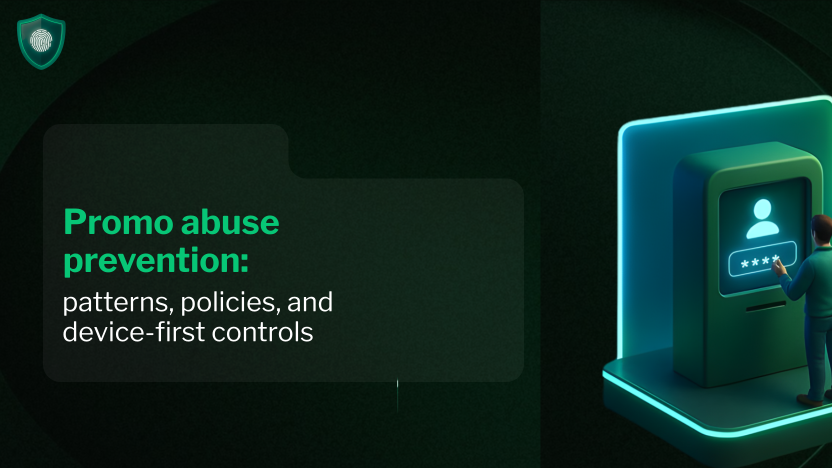
Promo abuse prevention: patterns, policies, and device-first controls

Deepak Raj
VP Tech
Summarize this article with
The growth teams are fond of promotions since they attract new users. However, these incentives also are a magnet for criminals who use systems weaknesses for profit. If you don't have a strategy your marketing budget could end being deposited in the pockets of swindlers, not loyal customers. This guidebook offers a practical four-step system to detect how to stop, prevent, and end the abuse of promotions at a large scale.
What is Promo Abuse?
Promo fraud occurs when customers manipulate a company's marketing offer to obtain illegal discounts, credits or other rewards. While it may appear to be an issue of minor importance but it's a type of multi-account fraud which can cause massive losses to your profits.
As the price for the customer acquisition (CAC) is rising, companies are offering higher incentives. Fraudsters have been noticing. They employ automated tools to expand their attacks, which makes it difficult for basic security checks in order to stay ahead.
Common Types of Promo Abuse
To fix the issue the issue, first you need to recognize how it manifests
Multi-accounting: Users set up hundreds or even dozens of accounts to receive the "new user" discount multiple times.
Referral fraud: One person is referred to repeatedly by via different email addresses or devices to receive referral rewards.
Coupon farming: Criminals are able to collect and sell unique discount codes through third-party forums or channels on Telegram.
Bot-driven abuse: Scripts automate fill in sign-up forms, and then apply promo codes at speeds that no human could ever match.
Why Traditional Prevention Fails
The majority of companies depend heavily on "legacy" signals that worked in the past, but can be easily discarded:
OTP/Phone Verification Fraudsters employ "SIM farms" or virtual numbers to bypass SMS verification to make pennies.
IP Tracking: Using the use of residential VPNs and mobile proxies A single fraudster can appear to be from many different places.
Email Ageing: Scammers buy aged Gmail accounts in large numbers and make their fake profiles appear to be genuine long-term users.
The Promo Abuse Prevention Playbook
A successful strategy shifts beyond static checkpoints and towards the use of behavioral intelligence. Take these steps in order to ensure your growth efforts.
Step 1: Identify Risk Signals
Start by examining more than your email addresses. The most risky indicators are:
Device Spoofing: Are they trying to hide their true hardware ID?
Emulator Detection What is"Cell "phone" actually a piece of software that runs on the laptop?
Velocity spikes: Are you seeing 500 sign-ups for the same small area within 10 minutes?
Step 2: Detect Multi-Account Users
Fraudsters typically leave behind a "digital fingerprint" even when they change their IP.
Fingerprinting on devices: Link accounts that share the same hardware features.
Pattern Recognition Recognize "clusters" of accounts that have the same navigation pathway or sign-up in a matter of seconds.
Step 3: Apply Risk-Based Controls
Every user shouldn't have to experience the same challenges. Make use of dynamic rules to ensure your users' experience
Lower Risk: Let the customer redeem the offer immediately.
Medium Risk: You must have "step-up" authentication, such as a check for ID from a government agency or live selfie.
High Risk: Block the transaction totally prior to the promo code being even applied.
Step 4: Monitor & Adapt
Fraud isn't an "set it and forget it" issue. Monitor the "Promo-to-LTV" (Lifetime Value) ratio. If the users of a particular campaign don't make a subsequent purchase, then you may have an abuse issue that is hidden.
How DeepID Helps
DeepID offers the infrastructure needed by teams to run this playbook in real-time. Contrary to the basic tools which only examine one particular signal, DeepID analyzes the entire user's identity.
Correct Detection system determines the root device and is capable of blocking fraud with multiple accounts, regardless of whether the user clears their cookies or connects via the VPN.
Real-time Decisions: DeepID incorporates itself directly into the sign-up process which allows you to decide whether or not to approve the promotions within milliseconds.
Reduction in Abuse, Higher ROI: By eliminating the bad actors your marketing budget goes further, and your profits reach customers that actually help grow your business.
Best Practices for Teams
Delay Rewards: Don't give out "instant" cash. Require a minimum spend or a 24-hour waiting period to disincentivize bot farms.
Monitor "New User" Density: If 90% of your new users are coming from one specific device type or region, investigate immediately.
Bridge the Gap: Ensure your Marketing and Fraud teams meet weekly. Growth should never launch a campaign without Fraud reviewing the mechanics.
Use Hardware Signals: Software signals can be faked; hardware signals (like the specific GPU or battery health of a device) are much harder to spoof.
Conclusion
Promoting abuse prevention is not merely a security concern but a growing necessity. Moving from basic filters to a sophisticated risk-based strategy, you will be able to ensure your margins are protected without affecting the experience of customers. Don't be impatient and let your budget disappear before putting together your defense.
All article tags
Related Articles
September 28, 2026
What is Behavior Analysis and how does it prevent fraud?
September 10, 2026
How to Prevent Password Sharing: A Complete Guide for SaaS & Streaming Platforms
August 31, 2026
How to Prevent Coupon Fraud? Effective Strategies
August 27, 2026
DoT SIM Binding Mandate Explained: Compliance Guide for Communication Apps (2026)
Identify your web and
mobile traffic in minutes
Collect visitor IDs and signals instantly for free,
or reach out to our team for a demo.
250+
countries and territories where we identified devices_
4 Billion +
unique browsers and mobile devices identified_
50 Million +
real-time device intelligence API events per day processed_