
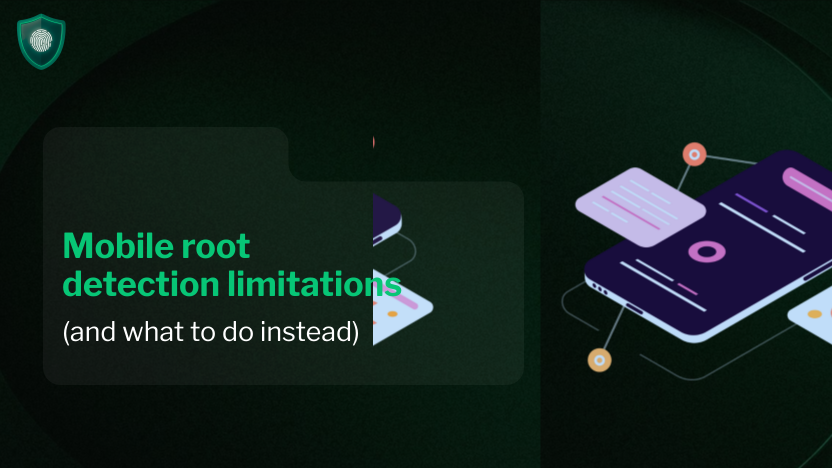
Mobile root detection limitations (and what to do instead)

Deepak Raj
VP Tech
Summarize this article with
Mobile fraud is growing faster than the majority of security teams can keep pace with. For many years Root detection has been the most effective method for safeguarding mobile applications. It was the initial protection against altered devices and criminal actors.
Currently, relying only upon root-based detection akin to locking your front door and not closing all the windows. The criminals have discovered inventive ways to bypass the security checks, which makes it essential for companies to develop more sophisticated methods of device intelligence.
What is Mobile Root Detection?
Mobile root detection is a security measure which determines whether the user has gained access to administrative control over their device. On Android this is referred to as "rooting," and on iOS this is referred to in the form of "jailbreaking."
At a high-level the checks are looking for particular files or changes to the system that shouldn't be present. If a device is rooting and it's a sign that the security limits established by the manufacturer have been rescinded.
Why Root Detection is Important
Root detection has a specific goal: it identifies devices that are riskier. A device that is rooted allows users to alter the way applications operate, steal information, or alter their locations.
The majority of fraud detection systems employ root checks to block:
- App Tampering: Changing the application's code in order to skip payments or to bypass limitations.
- Data Theft: Obtaining sensitive data stored in the application.
- System Compromise: Identifying devices which are more susceptible to malware.
Key Limitations of Root Detection
Although it is helpful, root detection can have important inconsistencies that fraudsters from the professional world use each day. This is the reason it frequently does not work in real-world scenarios.
Easily Bypassed by Advanced Users
Modern tools for fraud, such as Magisk or other "Root Hide" modules, can completely hide a phone's status. They can make a phone that is rooted appear as normal to security headers, rendering normal tests useless.
Does Not Detect Emulators Effectively
The most common method used by fraudsters is to use emulators, software which mimics the look of a phone running on computers. The majority of emulators allow for running apps but aren't "rooted" in the traditional sense, but they permit massive automation as well as "botting" that root detection will not be able to detect.
Misses Behavioral Fraud Patterns
The device doesn't have to be grounded for fraud. Scammers make use of "clean" devices for account control, fraudulent abuse as well as social engineering. Root detection is unable to discern what a person is up to, but only what the device is doing.
High False Positives
Certain powerful users have their phones rooted to enhance their privacy or personalization. Blocking all devices with root is a risk to fraud and can result in significant "false positives," where you block legitimate, high-value clients and impede your growth.
Why Root Detection Alone Is Not Enough
Cyber fraud has evolved into multiple layers. Nowadays, attackers don't use one phone with a root. They use device farms as well as sophisticated scripts and even residential proxies to appear like regular users.
If your security system just looks for the "root" flag, you have missed the larger picture. It is important to determine whether the phone is actually a physical phone, and if the location is fake and if the behaviour is that of a real person or bot.
A Modern Approach to Fraud Detection
To stay ahead, security teams are using device intelligence. This involves analyzing hundreds of small signals to calculate a "risk score" for every session.
Modern stacks include:
Device Integrity: Determine whether the OS and hardware were manipulated beyond rooting.
Behavior Signals: Examining how users interact with the application (e.g. speed of typing or patterns of touch).
Network Analysis: Determining whether an individual is hiding behind a VPN or a fraud-prone data center.
How DeepID Improves Fraud Detection
DeepID was designed to address this "blind spot" problem. We realized that merely flags don't suffice to deter the professional fraud rings. Our platform goes above and beyond mobile security and provides comprehensive, actionable information.
Multi-Signal Detection
Instead of an "Yes/No" root check, DeepID analyses hundreds of information points. We identify emulators screen mirroring, app Cloning, as well as virtual environments that other tools do not detect.
Higher Accuracy, Lower Friction
With its sophisticated risk scoring techniques, DeepID assists you in identifying real threats, without blocking your genuine customers. This means fewer manual checks for your fraud department and an easier customer experience.
Reduced False Positives
Our technology can distinguish between a phone that is rooted by a developer and a fraudster's computerized attack. This will allow you to expand your business in a safe manner without causing unnecessary blockages.
Best Practices for Fraud Teams
If you're looking to improve your mobile security Follow these practices:
Do not rely solely on one signal: Mix root detection with network and behavioral data.
Watch for emulators: specifically look for indications that the application has been installed on a computer instead of a mobile.
Use risk-based friction: only confront customers (with the aid of 2FA, or perhaps a manual check) in cases where their risk score is high.
Update your SDKs frequently: Fraudsters upgrade their bypass tools every week and your security should keep up-to-date.
Conclusion
Root detection is an effective instrument, but it's only one part in the overall puzzle. In order to protect your company in an era of sophisticated fraudulent mobile devices, you require an effective defense that is multi-layered, looking at the mobile device and the internet and the actions.
The transition from simple detection to real-time machine intelligence can be the sole way for you to be two steps ahead criminals.
All article tags
Related Articles
September 28, 2026
What is Behavior Analysis and how does it prevent fraud?

September 10, 2026
How to Prevent Password Sharing: A Complete Guide for SaaS & Streaming Platforms

August 31, 2026
How to Prevent Coupon Fraud? Effective Strategies
August 27, 2026
DoT SIM Binding Mandate Explained: Compliance Guide for Communication Apps (2026)
Identify your web and
mobile traffic in minutes
Collect visitor IDs and signals instantly for free,
or reach out to our team for a demo.
250+
countries and territories where we identified devices_
4 Billion +
unique browsers and mobile devices identified_
50 Million +
real-time device intelligence API events per day processed_