
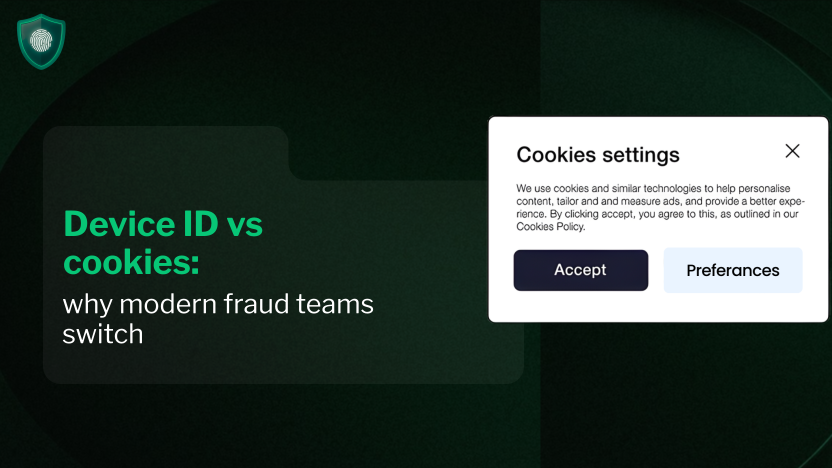
Device ID vs cookies: why modern fraud teams switch

Deepak Raj
VP Tech
Summarize this article with
The digital landscape is evolving. As privacy regulations become more stringent and browsers eliminate traditional tracking, companies are moving towards a completely cookie-free future. Knowing the distinction of Device identification and cookie isn't just for developers. It's an essential decision for team members in fraud and product management that must be able to determine the identity of users with accuracy.
What are Cookies?
Cookies are tiny text files that are stored inside a web browser of a user's. While you are on a site it sends cookies to your browser in order to "remember" who you are. They function like an electronic ID card that allows websites to provide seamless experience.
There are two major kinds of cookies:
First-party cookies: They are created by the site you're currently browsing. They keep track of your login details or the items you have added to your cart for shopping.
Third-party Cookies: These are cookies created in the name of "other" domains (like advertisers). They track your actions across multiple websites in order to build your profile of interests.
While cookies have been a standard for a long time however, they're only limited to browsers. When a user clears their cache, or changes between Chrome to Safari and back, their "memory" is lost.
What is a Device ID?
The Device ID is a unique identifier linked to a device, like laptop, smartphone or tablet. Unlike a cookie that is stored within the browser, a Device ID is tied to the hardware and software features of the device itself.
Imagine it as an electronic fingerprint. Even if the user erases their browser history or chooses to use "Incognito" mode, the device will remain the same. This is what makes Device IDs considerably more secure and more difficult to alter than files created by browsers.
Why Cookies Are Becoming Less Reliable
"The "Death of the Cookie" is a hot topic with a reason. Many factors make cookies less effective in modern companies:
Privacy regulations: Legislations such as GDPR as well as CCPA have made it mandatory for websites to request consent for cookies that many users refuse.
Browser Restrictions: Safari (ITP) from Apple Safari (ITP) along with Google Chrome are actively restricting or blocking the life span of cookies.
User Behavior: Users are becoming more technologically adept. A lot of users browse in private mode or install extensions that wipe out cookies every time a tab closes.
Why Device ID is Better for Modern Use Cases
In an age of cookie-free browsing companies need a method to identify users, and not rely on unreliable browser files. Device IDs are the best solution for:
Effective fraud detection: Identifying "bad actors" who use multiple accounts on the same device.
Account Security: Identifying the possibility of a login attempt from a suspicious, unrecognized device.
Accurate Analytics: Understanding the real number of unique visitors, rather than just counting "sessions."
How DeepID Device ID Helps
Modern businesses require more than just basic IP tracking. They require intelligen-tracking. This is the place where DeepID Device ID comes into play.
Instead of relying on easily eraseable cookie data, DeepID uses advanced device fingerprinting and device intelligence to provide a precise, permanent identification. It doesn't "tag" a browser; it recognizes the device's specific DNA.
Through the integration of DeepID the teams can:
Maintain a 99.9% accurate user signal even when cookies are blocked.
Find out immediately the presence of an VPN proxy, proxy, or emulator to conceal their identity.
Offer a seamless experience for genuine users, while securing high-risk traffic.
DeepID is focused on the outcomes. It allows your application to "remember" a returning customer without having them verify frequently, resulting in more conversion rates and lower friction.
When to Use Cookies vs. Device ID
It's not possible to create an "either/or" situation. The most successful SaaS businesses employ the hybrid method.
Cookies can be used for things like storing the language preferences of a user or keeping sessions running for a couple of hours.
Device ID can be used for High-risk activities like processing transactions or opening new accounts and identifying complex patterns of fraud.
If your primary goal is security or growth over the long term, relying on Device ID is the way to go.
Conclusion
The shift to cookie-free tracking offers the chance to create an improved, secure digital experience. Although cookies are still essential to perform simple tasks, they are not sufficient when it comes to contemporary privacy and fraud standards. When you move towards Device ID technology to ensure that your business remains reliable, accurate, and prepared for the next phase of the internet.
Also Read:
All article tags
Related Articles

September 28, 2026
What is Behavior Analysis and how does it prevent fraud?

September 10, 2026
How to Prevent Password Sharing: A Complete Guide for SaaS & Streaming Platforms

August 31, 2026
How to Prevent Coupon Fraud? Effective Strategies

August 27, 2026
DoT SIM Binding Mandate Explained: Compliance Guide for Communication Apps (2026)
Identify your web and
mobile traffic in minutes
Collect visitor IDs and signals instantly for free,
or reach out to our team for a demo.
250+
countries and territories where we identified devices_
4 Billion +
unique browsers and mobile devices identified_
50 Million +
real-time device intelligence API events per day processed_