
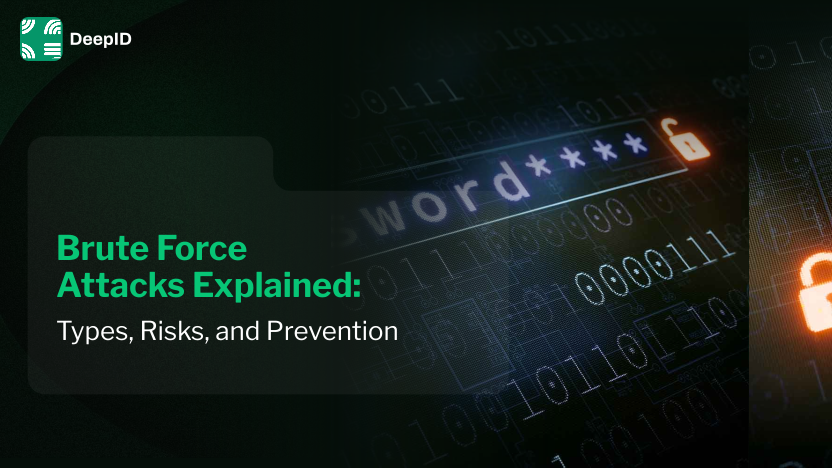
Brute Force Attacks Explained: Types, Risks, and Prevention
Vijay Kandari
Digital Marketing Executive
Summarize this article with
Your business's data is its greatest asset, yet its safety depends on passwords protecting it. Understanding brute force attacks is essential for businesses to keep their platform safe. Hackers frequently use this method to break into business systems. They use software to guess login credentials over and over until they gain entry - potentially leading to data leaks, losing customer trust and revenue.
In this blog we'll explain brute force attacks, discuss how automated brute-force attacks work and provide you with effective prevention methods to keep your business safe.
What Is A Brute Force Attack?
Imagine a thief attempting to open a vault by trying every combination on its lock until one works - finally, the vault is unlocked, and the thief opens it!
A brute force attack is a trial-and-error technique used by hackers to guess login credentials, encryption keys, or hidden web pages without employing sophisticated malware or social engineering methods. An attacker uses sheer repetition as their method.
Types of Brute Force Attacks
Not all brute-force attacks look the same. Hackers use different types depending on their goals and the information they already have.
Simple Brute Force: This is the most basic form. An attacker manually or automatically tries to guess a password without any outside information. For example, trying "123456" or "password" on a standard login screen.
Dictionary Attacks: Rather than randomly entering passwords, the attacker employs a "dictionary" consisting of standard words, common phrases, and previously exposed passwords. They presume a significant number of people pick words from a lexicon or simple repeating patterns.
Credential Stuffing: This is a highly effective modern attack. Hackers take lists of usernames and passwords robbed from any website (for example, a social media leak) and enter those credentials into other sites, (for example, a banking portal). They gamble that most people use the same password for several other platforms.
Hybrid Attacks: A hybrid attack combines dictionary words with symbols or numbers. For example, if the dictionary word is "Security," the software might try "Security123" or "S3curity!".
Reverse Brute Force Attack: A reverse brute force attack is when the hacker uses a common password like “admin123” across multiple accounts to gain access to other people’s accounts.
How Brute Force Attacks Work
Hackers use automation tools and bots for Brute Force Attacks.
Target Selection: The attacker identifies a login portal (like an employee's remote desktop or a customer login).
Tool Setup: They use specialized software designed to send thousands of requests per second.
The Process: The bot automatically enters a username and starts cycling through an if-else sequence of potential passwords.
Access: Once the bot hits the correct combination, it alerts the hacker, who then gains full access to the account.
Does Brute Force Attack Succeed?
Yes, brute force attacks do succeed, but it depends on several factors.
Password Length and Complexity: A 6-character password can be cracked in seconds. A 16-character password with symbols and numbers could take trillions of years to crack using current technology.
Computational Power: A stronger computer is more efficient.
Security Measures: If a website has no "rate limiting" (meaning it allows infinite login attempts), a brute force attack will eventually succeed.
Impact of Brute Force Attacks
The impact of a successful attack goes far beyond a simple "hacked account."
Data Breaches: Unauthorized access to sensitive customer data or intellectual property.
Financial Loss: The cost of recovering from a breach often includes legal fees, ransom payments, and lost revenue during downtime.
Reputation Damage: Customers lose trust in brands that cannot protect their personal information.
Compliance Violations: For businesses in healthcare or finance, a breach can lead to massive fines under regulations like GDPR or HIPAA.
How to Prevent Brute Force Attacks
Use Strong, Unique Passwords: A strong password is difficult for brute force bots to crack, a strong password generally has 6+ alpha-numeric characters in uppercase and lower case, special characters (like @, #, %). It is recommended to have a password with 12+ characters.
Implement Multi-Factor Authentication (MFA): With MFA authentication enabled on all your accounts, even if the hacker gets your credentials it won’t be able to access your account as the hacker would be unable to bypass the second layer of authentication.
Account Lockouts: Set your account to be locked if there are more than 3-4 failed login attempts.
Rate Limiting: Businesses can limit the no. of login attempts on their platforms by a single user in a single timeframe.
Use CAPTCHAs: CAPTCHAs prevent bots from working on your platform, as they can only be cleared by human users.
Conclusion
The first step in protecting your business is knowing what is a brute-force attack. Though brute-force attacks are relatively easy to execute; They can do a great deal of damage. Strong password policies, multi-factor authentication (MFA), and rate limiting can help transform your “front door” from a legal breach to a place of safety.
FAQs
Ques: What is a brute force attack?
Ans: A brute force attack is a cyber-attack where the hacker tries to guess your password combination and gain unauthorized access to your accounts.
Ques: What is a reverse brute force attack?
Ans: Reverse brute force attack is cyber-attack where the hacker tries a single common password across multiple accounts to gain unauthorized access.
Ques: What are the types of Brute-Force Attacks?
Ans: Following are the types of brute force attacks:
Simple brute force attack
Dictionary attack
Credential Stuffing
Hybrid Attack
Reverse Brute Force Attack
Ques: How to prevent brute force attack?
Ans: Use Strong, Unique Passwords:
Implement Multi-Factor Authentication (MFA):
Set Account Lockouts after a certain number of failed login attempts.
Businesses can set Rate Limiting on their platforms.
All article tags
Related Articles
September 28, 2026
What is Behavior Analysis and how does it prevent fraud?
September 10, 2026
How to Prevent Password Sharing: A Complete Guide for SaaS & Streaming Platforms
August 31, 2026
How to Prevent Coupon Fraud? Effective Strategies
August 27, 2026
DoT SIM Binding Mandate Explained: Compliance Guide for Communication Apps (2026)
Identify your web and
mobile traffic in minutes
Collect visitor IDs and signals instantly for free,
or reach out to our team for a demo.
250+
countries and territories where we identified devices_
4 Billion +
unique browsers and mobile devices identified_
50 Million +
real-time device intelligence API events per day processed_