
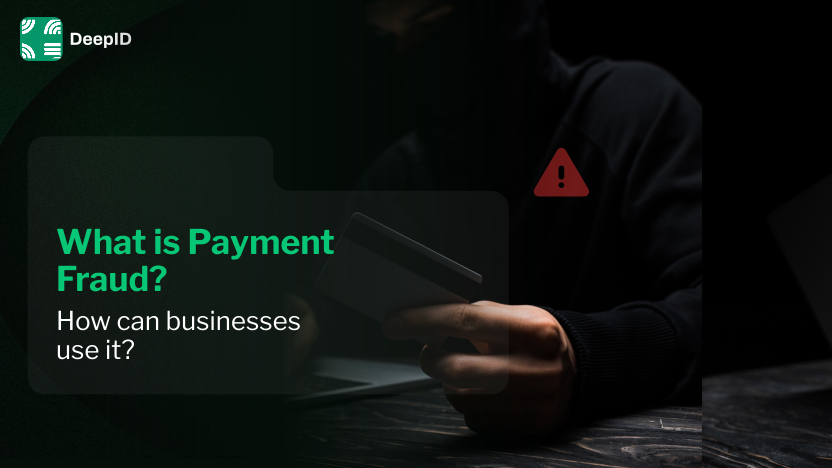
What is Payment Fraud? How can Businesses Prevent it?
Vijay Kandari
Digital Marketing Executive
Summarize this article with
Payment fraud is a rising concern for businesses and people. Every year thousands of cases are registered. This makes it extremely important to be aware of the fraud. It helps you prevent the loss. Here in this blog, you will learn about payment fraud, its types, and how to prevent it.
What is Payment fraud?
Payment fraud is a criminal or deceitful activity in which someone takes money or financial data in a transaction. Fraudsters employ various strategies to commit fraud, like the use of phishing and identity theft or compromised bank accounts.
What are the types of Payment Fraud?
There are mainly five types of payment fraud:
Social Engineering and Scams
Phishing/Smishing: Fraudsters and fraudulent emails, text messages, or use IVR (automated voice calls) pretending to be banks or officials. It tricks you into sharing passwords or clicking malicious links to steal data.
Authorized Push Payment (App) Fraud: In this kind of fraud, the victim is manipulated or deceived into willingly transferring money to an account controlled by a scammer. (e.g., fake job offers and investment scams).
Business Email Compromise (BEC): Attackers use impersonation and represent themselves as executives or suppliers via email to request an urgent change to standard payment routing or wire transfers.
Card and Account Fraud
Card Not Present (CNP) Fraud: A fraudster uses stolen credit or debit card details to make a purchase online or over the phone, in which a physical card is not present.
Account Takeover (ATO): Scammers gain unauthorized control of a legitimate user’s online banking or shopping account through stolen credentials.
Skimming and Cloning: Criminals use physical devices attached to ATMs or point of sale (POS) machines to copy your card’s magnetic strip and PIN.
UPI and Digital Wallet Fraud (Prevalent in India)
Fake Collect Requests: Fraudsters use fake payment receipts or refund requests on UPI. It tricks the victim into entering their UPI PIN and authorizing a deduction.
QR Code Scams: In this scam, fraudsters replace legitimate merchant QR codes at shops with their own or send fake QR codes promising quick transfers.
SIM Swap: Fraudsters hijack a victim’s phone number to intercept a one-time password (One Time Passwords) required to approve transactions.
How to Prevent Payment Fraud?
These are common prevention methods you should know:
Use multi-factor authentication (MFA) for payment systems and customer accounts.
Businesses dealing with PII should encrypt sensitive payment and customer data to prevent unauthorized access.
Regularly update payment software, security patches, and firewalls.
Train employees to identify phishing emails, fake invoices, and social engineering attacks.
Businesses should verify customer identity using KYC and authentication checks.
Integrate secure payment gateways and PCI DSS-compliant systems.
Implement fraud detection tools, powered by AI and behavioural analysis
Limit employee access to sensitive financial information
Set payment transaction limits and alerts for unusual payment activity
Avoid using public Wi-Fi for financial transactions
Inspect ATMs and POS machines for tampering or skimming devices
Conduct regular audits and vulnerability assessments
Verify vendor or bank account changes through secondary communication channels
How does DeepID SDK Business prevent payment fraud?
DeepID is a mobile security, device intelligence, and fraud prevention platform. It is designed to help businesses detect and shop payment fraud in real time.
Device Fingerprinting
It creates persistent device identifiers that remain the same whether the user re-installs the app, performs a factory reset, or uses incognito mode. It helps businesses identify repeat fraudsters and suspicious devices.
Real Time Risk Signals
It analyzes fraud indicators such as emulators, rooted devices, app cloning, GPS Spoofing, VPN usage, automation tools, and suspicious behaviour patterns before payment is approved.
SIM Intelligence and SIM Swap Detection
It detects SIM Swaps, carrier anomalies, recycled numbers, and suspicious mobile and activity that are often linked to OTP fraud and account takeovers.
Behaviour Monitoring
It continuously monitors sessions and flags when a previously trusted user suddenly behaves suspiciously during login, checkout, or payment events.
How to do Online Payment fraud complaints?
Follow these steps to file an online complaint:
Immediately Report to the Bank or Payment Provider
Report to the bank, UPI app, Credit/Debit card issuer, and wallet provider regarding the app. Kindly ask them to block the card/account, freeze suspicious transactions, and raise a chargeback or dispute request.
Report to National Cyber Crime Portal
File a complaint on the Government of India cybercrime portal to the National Cyber Crime Reporting Portal.
Call the Cybercrime Fraud Helpline - 1930
Dial 1930 immediately and freeze fraudulent transfers, coordinate with banks and payment intermediaries.
File an FIR if Required
Visit your nearby cybercrime police station to file a complaint.
Conclusion
Payment fraud is increasing day by day. It is a threat for businesses and individuals. Being aware of the various payment fraud helps individuals and businesses avoid it. The common methods used for fraud are phishing, authorized push payment app fraud, skimming, QR fraud, etc. Prevention tips and using a payment fraud and security solution is necessary.
FAQs
Ques: What is an example of payment fraud?
Ans: Credit card fraud, account takeover, QR code, and UPI scams are examples of fraud.
Ques: What is fraud in payments?
Ans: It is an unauthorized, deceptive, or illegal transaction where cybercriminals manipulate payment systems to steal money or sensitive data from individuals and businesses.
Ques: What are the common signs of payment fraud?
Ans: Unexpected OTP requests, unauthorized transactions, fake payment screenshots, and suspicious UPI collect, etc.
Ques: What is the difference between phishing and smishing?
Ans: Phishing uses fake emails or websites to steal information while smishing uses fraudulent SMS or messaging apps to trick users into sharing sensitive data.
Ques: How do fraudsters misuse QR codes?
Ans: Fraudsters replace genuine QR codes with fake or manipulated QR codes to receive money.
All article tags
Related Articles
September 28, 2026
What is Behavior Analysis and how does it prevent fraud?

September 10, 2026
How to Prevent Password Sharing: A Complete Guide for SaaS & Streaming Platforms
August 31, 2026
How to Prevent Coupon Fraud? Effective Strategies
August 27, 2026
DoT SIM Binding Mandate Explained: Compliance Guide for Communication Apps (2026)
Identify your web and
mobile traffic in minutes
Collect visitor IDs and signals instantly for free,
or reach out to our team for a demo.
250+
countries and territories where we identified devices_
4 Billion +
unique browsers and mobile devices identified_
50 Million +
real-time device intelligence API events per day processed_