
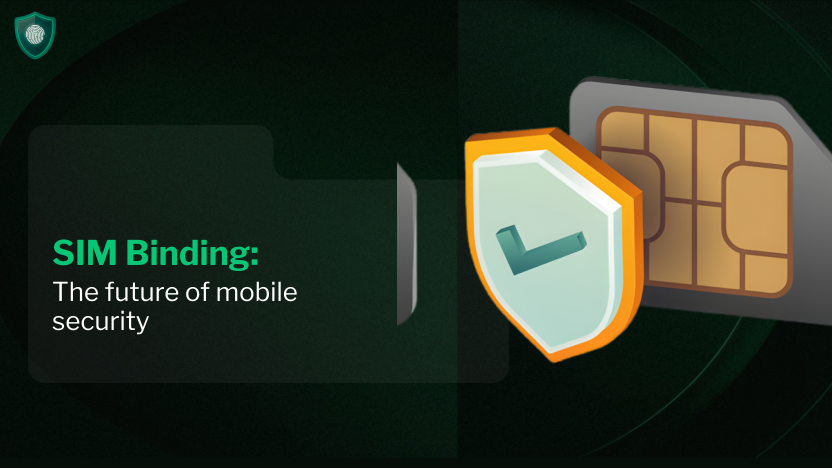
SIM Binding: The future of mobile security

Deepak Raj
VP Tech
Summarize this article with
Mobile applications serve as the primary gateway for banking, e-commerce, and communication. However, as dependency on these platforms grows, so does the risk of cyber attacks. Traditional security measures, such as SMS-based OTPs, are no longer sufficient to protect sensitive user data against modern fraud techniques like SIM swapping and man-in-the-middle attacks.
For businesses and platforms, the challenge lies in providing a seamless user experience without compromising on security. This is where SIM Binding emerges as a layer of defense.
What is SIM Binding?
SIM-binding, or 'app SIM binding', is an advanced security feature that creates a secure, cryptographic connection between the mobile application account and the actual SIM card (identified by its unique IMSI or ICCID) inside that mobile device. SIM binding does not use standard login methods like passwords or one-time passwords (OTPs); it uses hardware-based validation to verify the identity of the user.
By linking their digital identity to a verified SIM, you ensure that users will only have access to their accounts if the authorized SIM card is physically in the mobile device registered to it.
The Shift from Traditional OTPs to Hardware-Linked SIM Binding
For years, businesses have relied on OTPs as a secondary authentication factor. However, fraudsters have found multiple ways to intercept these codes:
SIM Swapping: Fraudsters convince telecom companies to port a number to a new SIM card under their control.
Social Engineering: Scammers trick users into revealing their OTPs through phishing calls.
SMS Sniffing: Technical exploits that allow criminals to intercept messages in transit.
SIM binding addresses these issues through hardware identifiers of the SIM card. This means that an OTP sent to a swapped or cloned SIM will never work if it is not tied to the underlying hardware identifiers that match the records on the platform.
Why Businesses Must Prioritize SIM Binding
Combating Account Takeover (ATO) and SIM Swap Fraud
The most important advantage for platforms is the almost complete eradication of SIM swap fraud. This is because the app will continuously or periodically check for the presence of the original SIM, and any attempt to log in with a different SIM, even with the correct password, will result in a re-verification process or an immediate block.
Meeting Global and Regional Regulatory Mandates
Regulatory bodies have begun to make SIM Binding compulsory. In India, the Department of Telecommunications (DoT) and Reserve Bank of India (RBI) have already issued guidelines to messaging and banking applications. For platforms, it is not a matter of compliance anymore, but a legal mandate to ensure national security.
Enhancing User Trust with "Silent" Security
Today's businesses aim to create a seamless experience for their customers; SIM Binding offers the ability to verify users through the use of background checks. Once SIM binding is established between the user and their device, any follow-up logins can be verified without requiring the user to wait for an OTP. This also increases the conversion rate thanks to a smooth login and browsing experience and strengthens a company's security.
How SIM Binding Works: A Step-by-Step Technical Overview
For a platform to successfully implement this technology, the following workflow is typically followed:
Initial Onboarding: During the first registration, the app reads the SIM-derived signals (IMSI/ICCID) via secure APIs.
Cryptographic Pairing: A unique digital signature is created, linking the app instance, the device fingerprint, and the SIM card.
Real-Time Verification: Every time the app is launched or a sensitive transaction is initiated, the platform performs a check to confirm the registered SIM is still active in the device.
Automatic Mitigation: If the SIM is removed or changed, the platform can automatically log out the user or restrict access until a secure re-binding process is completed.
SIM Binding: Protecting Diverse Industries
While banking and Fintech were the early adopters, other sectors are now integrating SIM Binding to protect their ecosystems:
E-commerce: To prevent Promo-code Abuse and the creation of fake accounts using virtual numbers.
Gaming: To ensure fair play and prevent multi-accounting.
Messaging Platforms: To curb impersonation and the spread of automated spam.
Conclusion
As the digital economy expands, the surface area for attacks grows with it. Businesses and platforms can no longer afford to be reactive. By implementing SIM Binding, organizations shift from a model of "detecting fraud after it happens" to "preventing fraud by design."
Integrating advanced security like the DeepID SDK provides the necessary tools to verify identity at the hardware level, ensuring that every session is bound to a real SIM and a trusted device. In an era where digital trust is the most valuable currency, SIM Binding is the most effective way to safeguard a platform’s future.
All article tags
Related Articles
September 28, 2026
What is Behavior Analysis and how does it prevent fraud?

September 10, 2026
How to Prevent Password Sharing: A Complete Guide for SaaS & Streaming Platforms
August 31, 2026
How to Prevent Coupon Fraud? Effective Strategies
August 27, 2026
DoT SIM Binding Mandate Explained: Compliance Guide for Communication Apps (2026)
Identify your web and
mobile traffic in minutes
Collect visitor IDs and signals instantly for free,
or reach out to our team for a demo.
250+
countries and territories where we identified devices_
4 Billion +
unique browsers and mobile devices identified_
50 Million +
real-time device intelligence API events per day processed_