
Behavioural Analysis vs Device Intelligence: Which One is Better for Security?
Team
Summarize this article with
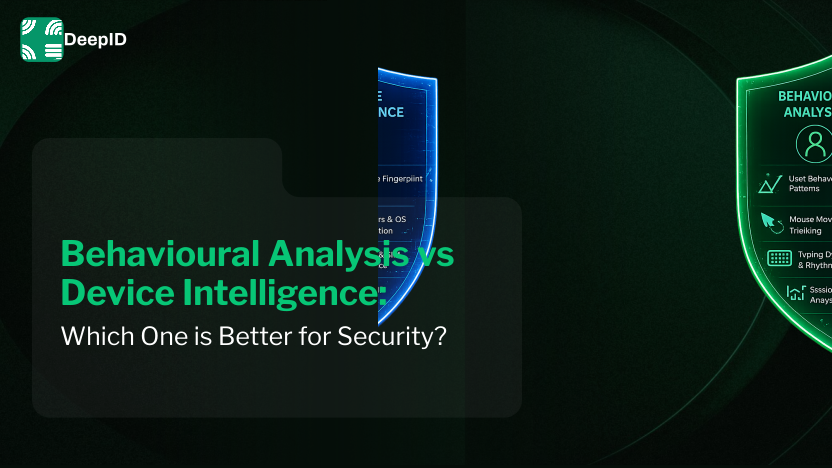
If you are looking for mobile app fraud prevention, you must have heard the two terms, behaviour analysis and device intelligence. Both of them help businesses detect fraud. But they work differently. If you are confused between behavioural analysis and device intelligence. You are in the right spot; just read this full blog.
What is behavioural Analysis?
Behavioural analysis is the practice of studying how a user interacts with a website or app, such as typing rhythm, mouse movement, and navigation speed, to tell a genuine person apart from a bot or fraudster.
It typically looks at:
Typing speed and rhythm
Mouse movement and touch patterns
How fast someone moves through a form
Whether actions repeat in a suspiciously identical way
A real person hesitates, makes small mistakes, and moves at an uneven pace. A script or bot usually doesn't. That contrast is what behavioural analysis is built to catch.
Limitations
New visitors: no history means nothing to compare against.
Ambiguous signals: three failed logins could be a hacker or just a forgetful user.
Skilled fraudsters: they can fake human-like pauses and mouse jitter.
False alarms: screen readers, unusual devices, or fast "power users" can look suspicious even when they're not.
What is Device Intelligence?
Device intelligence is the practice of analysing a device's technical fingerprint, such as browser settings, screen details, and network signals, to identify it and assess how much risk it carries, right from the first visit.
It typically looks at:
Browser and OS details
Emulators use
Screen resolution and installed fonts
Signs of a tampered or automated browser
Whether the person is hiding behind a VPN or proxy
These signals combine into a reliable fingerprint for a specific device. It works even if cookies are cleared or the IP address changes. And because it's not watching behaviour, it isn't confused by new UI designs, accessibility tools, or fast typers.
Limitation
It knows the device, not the person's intent in real time.
A "clean" device can still be used by a fraudster who is behaving oddly. Device intelligence alone won't catch that.
What is the Difference Between Behavioral Analysis vs Device Intelligence?
The two approaches differ in what they study, when they become effective, and where they fall short. Behavioral analysis studies user actions — how someone types, moves, and navigates — while device intelligence studies the device and environment itself, such as browser configuration and hardware signals.
Behavioral analysis works from the second visit onward, getting smarter over time as it builds a history to compare against. Device intelligence, by contrast, works from the very first visit, since it doesn't need repeated interactions to assess a device.
Each is best at catching different things. Behavioral analysis excels at spotting bots mimicking human clicks — scripts that move too smoothly or too consistently to be real. Device intelligence excels at catching repeat fraud, spoofed identities, and tampered browsers, since it can recognize the same risky device even across multiple accounts.
Each also has a weak spot. Behavioral analysis struggles with new users, since there's no history yet to compare against. Device intelligence struggles to see real-time intent — it can confirm a device is "clean" but won't catch a legitimate user suddenly behaving like a fraudster.
Finally, only behavioral analysis is affected by design changes — a UI redesign can throw off its baseline of "normal" behavior. Device intelligence is unaffected by design changes, since it isn't watching behavior at all.
Real-World Example Behavioural Analysis vs Device Intelligence
Imagine someone creates multiple accounts using different email IDs and phone numbers, but from the same rooted device.
Behavioural Analysis may see normal typing and navigation, so the activity looks genuine.
Device intelligence detects that the same risky device is being used repeatedly and blocks the fraud.
On the other hand, if a trusted user suddenly starts behaving unusually, behavioural analysis can detect the suspicious activity even though the device appears safe.
Why Companies Use Both?
One detects what the other misses. A new signup might look completely normal in terms of behaviour, but device intelligence can reveal that the same browser has already created ten accounts. Flip it around: a "known good" device might suddenly start behaving strangely, and behavioural analysis picks that up first. Used together, they help identify fraud far more accurately than either one alone. So, the business uses both together to reduce the chances of fraud.
How DeepID Brings the Two Together?
DeepID is a device intelligence and mobile app security platform built to close the gap between these two approaches. Instead of picking one signal type, it combines device-level and behavioural data into a Smart Signals risk picture.
On the device side, DeepID builds a persistent device fingerprint that survives app reinstalls, factory resets, and even incognito mode, so the same fraudster can't simply wipe their device and start over. It also detects rooted or jailbroken phones, emulators, VPNs, proxies, and SIM swaps, which are common tools fraudsters use to hide their identity.
On the behavioural side, DeepID watches device activity in real time and flags the moment a trusted user starts acting like a fraudster, catching account takeovers and abuse that a one-time device check would miss.
Because both signals feed into one platform, fraud teams get early warning from device data and ongoing confirmation from behavioural patterns, without stitching together separate tools.
Conclusion
So we have seen the difference between device behavioural Analysis vs Device Intelligence. Behavioural analysis watches what people do. Device intelligence watches what they're using to do it. If you have to choose only one, device intelligence usually provides broader protection because it works from the first interaction. However, the highest level of fraud prevention comes from combining device intelligence with behavioural analysis so that both the device and the user's actions are continuously evaluated.
FAQs
Ques: What is behavioral analysis in cybersecurity?
Ans: Behavioral analysis in cybersecurity is a fraud detection method that studies how a user interacts with a website or app, including typing speed, mouse movement, and navigation patterns, to distinguish real human activity from bots, scripts, or fraudulent behavior in real time.
Ques: What is functional behavior analysis?
Ans: Functional behavior analysis is an assessment method used in applied behavior analysis (ABA) that identifies why a behavior occurs by testing different conditions to find its trigger and the outcome that reinforces it, helping professionals design targeted interventions.
Ques: What is consumer behavior analysis?
Ans: Consumer behavior analysis is the study of how, why, and when people decide to purchase products or services. It uses data such as browsing habits, purchase history, and engagement patterns to help businesses predict buying decisions and improve marketing strategies.
Ques: How does applied behavior analysis work?
Ans: Applied behavior analysis (ABA) works by observing a specific behavior, identifying what triggers it and what reinforces it, then applying strategies such as positive reinforcement to encourage helpful behaviors and reduce harmful ones over repeated sessions.
Ques: What is device intelligence?
Ans: Device intelligence is a fraud prevention technology that identifies and assesses the risk of a browser or device using technical signals such as browser configuration, screen details, and signs of tampering.
Ques: What is the difference between behavior analysis and device intelligence?
Ans: Behavioral analysis studies how a user acts, such as typing speed and navigation habits, while device intelligence studies what device they use, such as browser and hardware fingerprints. Behavioral analysis improves with repeated visits; device intelligence works from the very first visit.
All article tags
Related Articles
September 28, 2026
What is Behavior Analysis and how does it prevent fraud?

September 10, 2026
How to Prevent Password Sharing: A Complete Guide for SaaS & Streaming Platforms

August 31, 2026
How to Prevent Coupon Fraud? Effective Strategies
August 27, 2026
DoT SIM Binding Mandate Explained: Compliance Guide for Communication Apps (2026)
Identify your web and
mobile traffic in minutes
Collect visitor IDs and signals instantly for free,
or reach out to our team for a demo.
250+
countries and territories where we identified devices_
4 Billion +
unique browsers and mobile devices identified_
50 Million +
real-time device intelligence API events per day processed_