
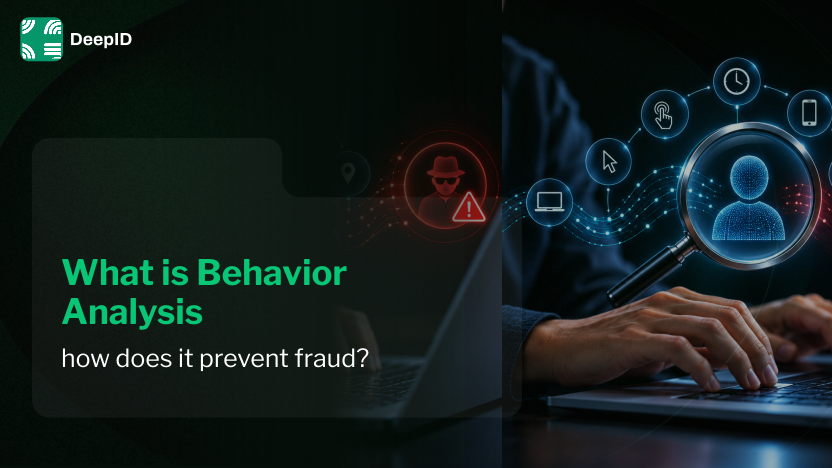
What is Behavior Analysis and how does it prevent fraud?
Team
Summarize this article with
Mobile app fraud isn’t hypothetical; someone’s data is getting exploited by the minute. RBI's bulletin recorded a 310% year-on-year rise in account takeover fraud, and by mid-2026, text-message-based scams targeting Indian banks had spiked 146%.
Companies still using traditional security keep getting attacked and the reason is simple. These old systems only check what you know (passwords and OTPs) and not who you actually are. Once someone has your password, they’re in, and then no further checks are made. Hackers know this and constantly misuse it. This misuse costs companies billions and damages the trust of customers.
This is where behavior analysis comes in. Instead of checking credentials once, it constantly watches how a user behaves. The way and speed the user type in, swipe, and move through the app. If something feels off, it flags it instantly. This helps to catch any imposter that passwords and OTPs could never detect.
To know about How Behavior Analysis Helps Businesses, read ahead.
What is Behavior Analysis?
Behavioral analysis is the continuous observation of user, device, and session signals to identify patterns that may indicate legitimate or suspicious activity, constantly checking-
User’s contextual behavior (navigation and location patterns, session timings, transaction habits)
User’s physical behavior (typing speed, tap pressure, swiping gestures, device orientation).
This physical layer is often called behavioral biometrics. This picks up on natural, habitual patterns that are nearly impossible to copy. Together, these patterns make it easy to spot anything unusual. Example- a login from an unusual location or an unexpected large purchase that doesn't match past behavior.
The aim is simple: differentiate real human interaction from bots or hackers. It has to do so by checking how this happened and not by what happened. By judging behavior in real time, it can catch social engineering, bots, and account takeovers. It can achieve this without slowing down or inconveniencing genuine users.
How Customer Behavior Analysis Detects and Prevents Fraud?
Behavioral analytics is used to detect and identify potential fraudsters. This identification is based on changes in their common user behavior patterns. This helps the companies to catch bad actors early enough by real-time monitoring. Here's how companies do it:
Large-scale Data Collection
Collecting a large volume of data by monitoring user activity. The data includes the customer's IP address, location, devices used, VPN usage, device/browser configurations, payment methods, login/logout times, session duration, and purchase patterns. This raw data is the foundation of every method below and without it, there's nothing to baseline, score, or track.
Behavior Biometrics Analysis & Anomaly Detection
The Anomaly Detection method builds a baseline of ‘normal’ behavior for each user. The system learns a user's normal habits, like typing speed and preferred locations. A sudden change from the set baseline would trigger a risk alert. This method is useful in detecting data breaches. As credentials can be stolen but the behavior can’t be replicated.
What it Stops: Account Takeover (ATO), remote-access scams, and credential stuffing.
Risk Scoring
Behavior analysis creates user profiles based on habitual patterns and behavior. The system assigns risk scores reflecting the likelihood of fraud. This turns raw behavioral signals into one actionable number. These signals then let a company decide whether to allow, challenge, or block an action.
What it Stops: Payment Fraud. Odd amount or location raises the score to activate hold before completing a transaction.
Real-time Monitoring
The analytics system constantly monitors user activity in real time. This makes it possible to flag suspicious activity as it occurs. When a customer's actions are different from their familiar patterns, the system generates an alert that stops a likely fraud.
Navigation and Session Analysis
Navigation and Session Analysis shows how users move through an app. Genuine users have a natural pace with occasional mistakes. But bots and fraudsters move way fast in repetitive sequences. This is useful for catching bots and scripted attacks that bypass login credentials.
Funnel Analysis
Funneling Analysis tracks the steps users take, like signing up or shows where users drop off. It helps in minimizing the fraud from new account fraud rings.
Retention Analysis
Retention checks how many users return to the application after their first visit. It is tracked through cohort return rates. This method helps in analyzing the factors that influence the user’s engagement levels. It stops scams known as Promo Abuse. In this, fake users log in to claim rewards, then log out after claiming the offer.
Segmentation Analysis
This method segments users by demographics, location, behavior, or usage pattern helps companies analyze specific groups. This segmentation helps tailor marketing or app features, while also minimizing synthetic identity fraud. It helps in minimizing synthetic identity fraud.
Heatmap Analysis
This helps the companies to visualize the user interaction patterns in the application. Through this they can look at which elements are popular and which are not. This helps to improve the UI/UX. This analysis also catches bot traffic as bots create flat heatmaps with uniform clicks and no genuine attention curve.
Case Study- How RBI’s "MuleHunter.AI" Detects Mule Account Behavior Across Indian Banks
Fraudsters need ‘Mule Accounts’ to launder their stolen assets to turn into digital money or cash. By late 2024, money mules were linked to over half of the fraud threats facing Indian financial institutions. The old, rule-based method had too many false positives and missed accounts.
The Reserve Bank Innovation Hub (RBIH) built MuleHunter.AI by studying how mule accounts actually behave. Rather than checking an account against the old static rules, the model looks at behavior patterns in transactions and account activity.
Over time the account is tracked and is assigned scores based on the likelihood that the account is being used as a mule. This continuous monitoring is faster and more precise than traditional rule-based systems.
MuleHunter.AI was launched in December 2024 to prevent and mitigate digital fraud. More than 15 Indian banks are using the MuleHunter.AI with one major bank achieving 95% accuracy in detecting mule accounts.
How DeepID Helps Businesses Stop Fraud?
When a business scales, it can't manually review every customer who visits its platform. Thousands of signups, logins, and transactions happen every hour. Checking each one of them is incredibly daunting and missing even one bad actor can cause serious damage.
This is exactly where DeepID comes in. It doesn’t rely on manual checks and static rules that nearly all of the fraudsters bypass. DeepID automatically reads the behavior behind every device and session.
DeepID sits in the background and tells businesses if a user is genuine or bad. This happens for each user with no added friction for real customers. This can save businesses money by stopping fraud before it happens.
Conclusion
Fraud and scams have moved past the point where a password or a static rule can keep up with them. Scammers now adapt faster than rule-based systems can keep up, letting them slip through unchecked.
Behavior Analysis provides a powerful shield against fraud. It continuously monitors and evaluates users in real time. After evaluation, it detects suspicious activities that the traditional fraud prevention methods might miss.
It works quietly in the background without disrupting genuine users. Silently it continuously analyses numerous behavioral indicators. When current user behavior deviates from established patterns, the system quickly identifies it. Then implements rapid intervention before any fraudster can cause damage.
FAQs
Ques: What is behavior analysis in fraud detection?
Ans: Behavior Analysis is a continuous process of studying a user or device in real time. The next step is flagging anything that deviates from the normal known pattern.
Ques: What are the benefits of behavioral analysis?
Ans: Companies who constantly monitor their customers can understand how users interact with websites, apps, and products so they can improve engagement, security, and sales.
Ques: What is the goal of behavioral monitoring in fraud detection?
Ans: The main goal is to detect frauds and stop fraudulent activity in real time. It is done by spotting unusual changes from established user patterns.
Ques: Can behavior analysis detect fraud before it happens?
Ans: Yes, by monitoring user signals in real time it can flag risk at signup or login before a fraudulent transaction or takeover occurs
Ques: How is traditional fraud detection different from behavior analysis?
Ans: The traditional fraud detection system relies only on static rules that are easily bypassed by any fraudster.
Behavior Analysis continuously learns and adapts what a normal pattern looks like for each user or device. If there are any changes from the set pattern, the system will flag that user or device.
Ques: Does behavior analysis slow down the experience for real, genuine users?
Ans: No, if implemented right it does the opposite. Trusted users with consistent, low-risk behavior move through with little to no halts.
Ques: Which industries benefit most from behavior-based fraud detection?
Ans: A high-volume digital business gets the most benefits as they have large user bases and real-time transactions. Some of these industries are fintech, e-commerce, gaming, streaming, and ride-hailing apps.
All article tags
Related Articles

September 10, 2026
How to Prevent Password Sharing: A Complete Guide for SaaS & Streaming Platforms
August 31, 2026
How to Prevent Coupon Fraud? Effective Strategies
August 27, 2026
DoT SIM Binding Mandate Explained: Compliance Guide for Communication Apps (2026)
August 13, 2026
How to Detect Mule Accounts: Types, Red Flags & Prevention Strategies
Identify your web and
mobile traffic in minutes
Collect visitor IDs and signals instantly for free,
or reach out to our team for a demo.
250+
countries and territories where we identified devices_
4 Billion +
unique browsers and mobile devices identified_
50 Million +
real-time device intelligence API events per day processed_